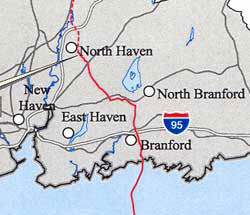
Islander East, Pipeline Proposal Overview
- On
June 15th, 2001 Islander East filed an application with the Federal
Energy Regulatory Commission requesting permissin to build a natural
gas pipeline from North Haven, Connecticut to Brookhaven and Calverton
on Long Island, New York. Another company, Iroquois Pipeline,
previously built a natural gas pipeline that ran from Milford,
Connecticut to South Commack on Long Island.
- Iroquois
Pipeline wanted to add an extension to their line that would connect
off the coast of Milford and travel on to Shoreham on Long Island.
Iroquois withdrew their request when the Islander East project was
approved by the Federal Energy Regulatory Commission.
- The
Islander East project is designed to establish a second and separate,
Long Island Sound crossing to increase the supply, security and
reliability of natural gas on Long Island.
- The
Islander East pipeline could easily serve future customers in
Connecticut and would increase the supply, security and reliability of
natural gas available to residents and businesses in our state as well.
- The
Islander East pipeline will connect to the Algonquin pipeline in
Chesire, Connecticut. The Algonquin pipeline is part of a 300,000 mile
network of gas pipelines that spread across the United States.
Algonquin, by contractual agreement with Islander East, will operate and maintain the Islander East pipeline.
- Natural
gas is often found in deep pockets beneath the earth's surface. It is
difficult to store so it is usually left deep underground until it is
needed.
- The
300,000 mile network or grid of pipelines allows natural gas to flow
from wells in the Gulf of Mexico, the western states and Canada to over
50 million homes and businesses throughout the United States. So
customers may be assured of a steady supply of natural gas several
pipelines, each from a different company, may be built to serve a
particular region. Competing pipelines often have connections to each
other so in the case of an emergency, customers will still be able to
get natural gas.
|