Project Overview Page 3
Project
Overview
Route in
Branford
Supporters,
Critic's Comments
and Rebuttals
Benefits
and
Losses
Links

Contact Us
How You
Can Help
Tim's Life.Com
Main Table of Contents
 
Safe and Clean Natural Gas
 
What is natural gas?
  • Natural Gas is a naturally occurring mix of hydrocarbon and associated gases, mainly methane, found in geologic formations beneath the earth surface. Typically, pockets of natural gas are found associated with petroleum.
  • Natural Gas can be used for many uses, from as simple a thing as cooking your dinner on your stove at home, heating your house, generating the electricity which powers just about everything, and even powering cars and buses.
  • Natural gas, of all the fossil fuels (those fuels created through the decaying of ancient plant and animal materials) has the smallest amount of pollution created when it is burned. When burned cleanly, only carbon dioxide and water are released. Due to inefficiencies in the burning process however pollutants such as carbon monoxide and nitrous oxide are produced. In addition, there are small amounts of chemicals in the natural gas such as sulfur and trace chemicals which can result in small amounts of pollutants being released. Because of this, the demand for natural gas has increased significantly in recent years.
  • The "smell" that people associate with natural gas is actually a chemical added to the gas so that people can tell if there is a leak. This family of chemical, called mercaptans, has a very pungent smell and when burned, will also contribute a small amount of pollutants to the atmosphere.
FERC Seal
FERC Seal
 
What are the Federal Energy Regulatory Commission's (FERC) responsibilities for regulating natural gas?
  • Granting permission to any company that wants to construct and operate interstate pipelines, interstate storage facilities for natural gas, or liquefied natural gas plants.
  • Granting permission to any company that wants to abandon facilities in place (when pipelines get old and the facilities need upgrading or to be removed and replaced with a new pipeline).
  • FERC does not regulate local distribution pipeline companies which are regulated by the state authorities. These companies service the pipelines that serve individual residences, commercial buildings, etc… These pipelines are usually smaller diameter in size and operate at lower pressure, and many are constructed of plastic instead of steel.
  • FERC does not regulate the development and operation of natural gas fueled vehicles, such as cars, buses, etc.
  • The above information is courtesy of the Federal Energy Regulatory Commission. Visit their well written and informative site at www.ferc.fed.us by clicking on the underlined text.
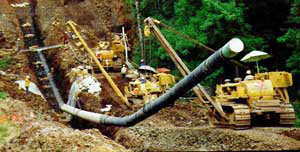
Pipeline is Buried Safely in Deep Trenches
Deep Trenches Protect the Pipeline
 
A Brief History of Natural Gas Regulation
  • The natural gas industry was first regulated by the federal government when the Natural Gas Act was passed in 1938. This bill gave the Commission rate-setting authority on the transmission of natural gas in interstate commerce. The bill was  based on a report prepared by the Department of Justice and the Federal Trade Commission which found that the pipeline industry was quickly becoming a 'natural monopoly'.
  • A natural transmission monopoly occurs when only one company owns the means of delivering a product, here natural gas. Because natural gas pipelines that are in interstate commerce (i.e., cross state borders) are extremely expensive and time-consuming to build, once built, it is easier for an owner of such a pipeline to exercise market power in any given market.
  • Recognizing the potential for this exercise of market power, Congress gave the Commission the authority to set just and reasonable rates for the transmission of natural gas in interstate commerce. Pursuant to a Supreme Court decision in 1956 (Phillips Petroleum v. FPC), the Commission received the authority to set natural gas prices at the wellhead (of sales for resale of natural gas in interstate commerce).
  • In 1993, prices at the wellhead were deregulated by an act of Congress, the Wellhead Decontrol Act of 1989. Thus, the price of natural gas, as a commodity, is deregulated, by act of Congress--that is, the price of natural gas is set by supply and demand.
  • The Natural Gas Act of 1938 also gave the Commission the authority to grant certificates to companies which want to build or enlarge natural gas pipelines in interstate commerce. A large portion of Commission's workload exists because of Section 7 of the Natural Gas Act.
  • Any company that wants to construct and operate interstate natural gas facilities, such as pipelines and natural gas storage facilities or liquified natural gas terminals would need authorization, or a certificate, from the Commission, in order to build and operate the project. This authority is called a Certificate of Public Convenience and Necessity.
  • The Commission staff which prepares the orders granting (or denying) the Certificate of Public Convenience and Necessity consists of a variety of economic, scientific, engineering and legal specialists who work hard to ensure that each proposed project provides just and reasonable rates for customers and adequate environmental protection. The Certificate team usually consists of a Pipeline Certificates Project Manager/Engineer, an attorney who specializes in energy infrastructure projects, and an Environmental Project Manager and/or team.
  • When the National Environmental Policy Act (NEPA) was enacted in 1969, the Commission became responsible for reporting the environmental impacts associated with the construction of interstate natural gas facilities.  Since then, thousands of environmental documents have been written and published by staff. The environmental staff conducts an independent review of the construction proposal and makes recommendations to the Commission to impose requirements on the applicant (if necessary) to reduce impacts in sensitive areas and habitats. This document is called an "Environmental Impact Statement" or "EIS." The environmental specialist of staff includes biologists, geologists, soil conservationists, engineers, archaeologists, and physical scientists.
  • The environmental documents discuss a variety of effects, including impacts on geology, soils, water quality (surface and groundwater), vegetation, wildlife, federally endangered and/or threatened species, cultural resources, land use, air and noise quality. Safety during construction is always discussed, although the agency directly responsible for safety of pipelines, both before and after construction, is the Department of Transportation, Office of Pipeline Safety. Another major feature of the EIS are alternatives to the proposed pipeline, including alternative routes.
  • Upon completion of the environmental review, the Certificates Project Manager will coordinate the final order among the project team to present to the Commission. The Commission will then decide whether to approve or disapprove the application. The final order addresses all the public's concerns that have been identified through the Commission's regulatory process. If the application is approved, the project can be constructed as soon as all the requirements are fulfilled by the applicant.
  • The above information is courtesy of the Federal Energy Regulatory Commission. Visit their well written and informative site at www.ferc.fed.us by clicking on the underlined text.
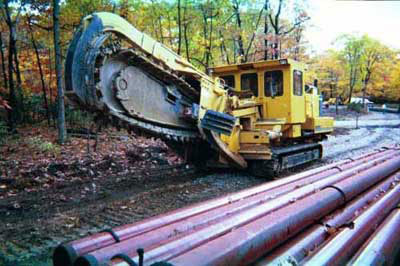
A Natural Gas Ditch Trenching Machine
Ditch Trenching Machine
 
Natural Gas Pipeline Construction
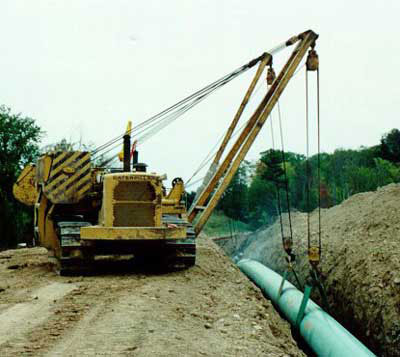
  • Pipelines are utilities that are buried underground and not seen when they are flowing gas. When constructed, they are buried in at least three feet of cover. Backhoes and trenching machines are used to dig trenches. The soil, or spoil, is stockpiled next to the trench and salvaged to be used again. The pipe, usually manufactured in 40 foot segments, is welded together and laid in the trench by a side boom. After the pipe is laid, the soil is placed back on the pipeline, and the construction area is restored and planted with new vegetation. To test the new pipeline and ensure there are no leaks, the pipe is hydrostatically tested. This means that water is pressurized into the pipeline to check for leaks.
  • Environmental staff continually monitor construction and restoration activities to ensure compliance with the Commission’s requirements. This includes several inspections where the project is being constructed. Photographs are taken of construction activities, and compliance reports are recorded. Staff usually looks at erosion control devices, such as curlex and silt fences, that keep unwanted soil from penetrating areas that are not affected by construction. When staff is convinced that construction activities are concluded and the project area is restored satisfactorily, then the applicant is allowed to turn on the gas for its new customers.
  • The environmental staff of the Division of Environmental and Engineering Review examine projects involving the construction, modification and abandonment of natural gas pipeline facilities. These include things such as the pipes through which gas is pumped, the compressors, or pumps, which push the gas through, and stations that meter the gas out to the customer. (Also storage facilities and LNG facilities).
  • The environmental staff reviews these projects to determine the impact that the construction and operation of the pipeline facility will have on human health and the environment. Depending upon the size and impact of the project, the Commission will prepare either an environmental assessment ("EA") or an environmental impact statement ("EIS") of the environmental consequences.
  • The above information is courtesy of the Federal Energy Regulatory Commission. Visit their well written and informative site at www.ferc.fed.us by clicking on the underlined text.
Lowering the Pipeline into the Trench
Pipeline Lowered into the Trench
 
Want to learn more about Natural Gas?

Click on the underlined text to visit these helpful Web sites.

http://www.fe.doe.gov/education/

http://www.energyquest.ca.gov/story/chapter08.html

http://api-ec.api.org/about/index.cfm?bitmask=001002002002000000

http://www.ferc.gov/students/index.htm

Natural Gas Association of America (INGAA), Education Section
http://www.ingaa.org/education/index.php?page=main


Click on the
underlined text to visit:
Project Overview

Page 1
What is the
Federal Energy
Regulatory Commission?

Page 2