Supporters & Critics Page 1
Project
Overview
Route in
Branford
Supporters,
Critic's Comments
and Rebuttals
Benefits
and
Losses
Links

Contact Us
How You
Can Help
Tim's Life.Com
Main Table of Contents
 
The pipeline will not supply any gas to Branford or Connecticut
  • In fact, the improvements to Algonquin's existing facilities and the new pipeline will make available new supplies of natural gas from Eastern Canada to Connecticut companies and consumers. Since no Connecticut natural gas distribution company has yet elected to participate in the project, the initial users of the new pipeline do not include Connecticut companies at this time. However, the proposed facilities will provide an opportunity for Connecticut companies to receive gas. When the Connecticut market is ready to do so, delivery points may be established along the new infrastructure that would provide for a more direct and economical access to multiple gas supply sources, including the recently developed Nova Scotia Offshore Reserves. Consumers in Branford and neighboring communities have received natural gas transported over the Algonquin system to The Southern Connecticut Gas Company since the early 1950's. Ninety percent of the natural gas flowing into Connecticut comes through the state of New York.
A minimum of 50 feet of clearcut area would need to be maintained over the pipeline in perpetuity
  • As required by the Federal Energy Regulatory Commission, only a 10-foot wide corridor will be maintained in a herbaceous state over the centerline of the pipeline in wetlands. Elsewhere, the cleared area will be a maximum of 50 feet or about the width of Main Street as it runs through Branford center. Much of the pipeline area is already cleared for existing right-of-way uses such as the Branford Steam Railroad and the Algonquin pipeline. Branford Land Trust areas will receive special consideration as outlined in the Islander East manual titled "Construction, Restoration, and Invasive Species Control Plan for the Branford Land Trust Properties". Copies are available at local libraries and the Islander East Branford office at 454 East Main Street.
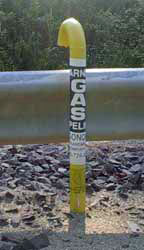
A yellow and white marker is usually all
you will see of an interstate gas pipeline
Gas Line Marker
 
The new pipeline "will create a new industrial corridor through Branford to Long Island Sound".
  • The term "industrial corridor" implies that there will be new visible industrial facilities throughout the corridor. In fact, the pipeline will be buried alongside the existing Branford Steam Railroad track. Following construction, the temporary and permanent rights-of-way will be returned to original contours and reseeded. Temporary construction right-of-way will be allowed to revert to its previous land use and cover type. A ten foot wide path directly over the pipeline will be maintained in a herbaceous state by periodic mowing. No herbicides or chemicals will be used to maintain the ten foot wide right-of-way on Branford Land Trust properties or on wetlands. Routine right-of-way maintenance on the ten foot wide ribbon will result in a meadowlike opening which will provide a diverse habitat for wildlife that is beneficial to many bird, mammal and plant species. The permanent pipeline right-of-way will be compatible with many recreational and wildlife uses.
"The drill would operate at 85 decibels for at least 3 months for 18 hours/day. The noise pollution would hurt both people and wildlife."
  • Eighty-five decibels is not an accurate value to use in describing the perceptions of people and wildlife unless you include a specific distance from the sound source. It is reasonable to expect a sound pressure level of 85 decibals if you put your ear within a few feet of the drill! Do not do that for you may damage your hearing. Actual noise levels heard by wildlife and residents will be much lower, if they hear anything at all.
    Noise from the directional drill operation will be substantially reduced by the use of noise abatement structures such as straw bales and sound dampening tents. In a similar recent drilling operation, Algonquin achieved substantial noise reduction in a residential area by employing straw bales and tents. Any noise that remains will dissipate exponentially over distance so it is highly unlikely that people or wildlife will be injured.
Tilcon barges are towed past the outermost Thimble islands by a sea going tug
Outer Thimbles and Tilcon Barges
 
There will be dredging off of the Thimble Islands. Siltation from the process will kill most shellfish.
  • It is a gross exaggeration to say that "most" shellfish will be adversely affected by the installation of the pipeline. The use of a horizontal directional drill for the maximum feasible distance of approximately 4,000 feet to drill a tunnel through the bedrock, up to 90 feet below the Town leased shellfish beds, will minimize any effect the pipeline will have on near shore shellfish. Only shellfish close to the pipeline installation area, seaward of the drilled portion are likely to be affected by the project. Only one mile will be dredged from the drill exit point to deeper water. Then the subsea plow will gently cut a furrow in the sea floor.
    The offshore construction will be done during the winter months, when shellfish are less active and less susceptible to disturbance.
Branford and Long Island Sound would be at risk for gas leaks and explosions. In the past 15 years, 3184 natural gas pipeline incidents have killed 328 people and caused $488 million in damage.
  • These statistics when used to describe a risk from the proposed Islander East pipeline are false and misleading. The statistics quoted above include local distribution gas lines that are placed in city streets where they are typically not well marked and are more vulnerable to frequent interference from the maintenance activities of other underground facilities, and may be unevenly maintained. Interstate natural gas transmission pipelines, like Islander East, are buried in dedicated rights of way, are well marked to indicate their location, are maintained according to rigorous federal requirements, and are closely monitored.

    Interstate natural gas transmission pipelines are in fact the safest mode of energy transportation. According to statistics published by the U. S. Department of Transportation, Office of Pipeline Safety, there have been a total of 1,190 incidents over the past 15 years (1986 through 2000) resulting in 56 fatalities and 215 injuries associated with all of the 300,000 miles of gas transmission pipelines located in the United States. Algonquin's safety record is unexcelled. It has operated natural gas pipeline facilities in Connecticut since 1953. Today, Algonquin operates and maintains approximately 1100 miles of pipeline throughout its system. Algonquin has never experienced a pipeline or equipment failure that has resulted in significant property damage or serious personal injury. Algonquin will operate and maintain the Islander East pipeline under contract to Islander East.
Islander East is formed as an L.L.C.. The cost of a disaster would fall on the taxpayers of Branford and Connecticut.
  • There is nothing sinister about an LLC. As most attorneys know well, the limited liability characteristic of the LLC form of organization is no different than that of a corporation. Since LLC's were authorized by the Connecticut legislature a few years ago, many substantial companies have formed them, including NRG Northeast Generating LLC, the owner of many of Connecticut's electric generating plants, and Aetna Capital LLC. To assure its financial responsibility, Islander East will be required to carry ample liability insurance, typical of that required of other natural gas transmission companies throughout the country.
Bird
The Islander East Pipeline right-of-way will destroy valuable bird habitat.
  • The Menunkatuck Audubon Society, have expressed concern regarding the potential impacts of pipeline construction on bird habitat and nesting. There is a general misconception that the Islander East Pipeline right-of-way will destroy valuable bird habitat by removing vegetation. In reality, the Islander East Pipeline right-of-way will create a shrubland habitat that will provide essential habitat for shrubland birds.

    Utility right-of-way vegetation is often managed to create a cover of shrubs that shrubland habitat bird species find irresistible. The vegetation along the Islander East route is diverse, with rock outcrops, flatlands with fertile soils, and wetlands. All are capable of supporting an abundance of shrubland species of birds. In one study, 92 different species of birds were identified that use managed utility rights-of-way for foraging, most of which who also appeared to have nesting territories in the rights-of-way. The same study indicated that shrubland birds are much more abundant in the northeastern region rights-of-way, due to the right-of-way management missions of utility companies, than in the northeast region in general, because of the decline in suitable shrubland habitat.(Confer)

    In the eastern United States, species of shrubland birds are declining as abandoned farmland passes through a shrubland stage and succeeds into second growth forests. The decline of farms and natural grasslands have caused a variety of citizen groups to request the Connecticut legislature to create a Grassland Reserves Program that will match the Farmland Preservation Program, and assist private land owners in creating shrubland habitat.

    As forest regeneration continues throughout the northeastern United States, managed habitat will become increasingly significant for shrubland bird species. The Islander East Pipeline right-of-way will provide a new, significant habitat for shrubland bird species to nest and forage.

    Confer, John. 2002. Density, Diversity and Nesting Success of Birds on Managed Shrublands of Northeastern United States: The Importance of Utility Rights-of-Way. Ithaca College, Ithaca, New York.

    Click on the underlined text to visit http://www.ct-botanical-society.org/newsletter/grasslands.html and read about grassland habitats.
Click on the
underlined text to visit:
Supporters and Critics
Page 2
Supporters and Critics
Page 3
Supporters and Critics
Page 4
Supporters and Critics
Page 5