![]() |
Branford Bike
129 Sagittarius Skyway, PO Box 1711, Emigrant, MT 59027 USA |
| Click on the underlined text to: | |
| order online via our Secure Order Form and receive FREE... | |
| or send us an email with your questions or comments. | |
|
Phone Answering Hours M-W-F, 12 noon - 3 PM Mountain Time Information: (203) 488-0482 FAX: (203) 643-8078 |
|
Headset, Seat Posts and Pedals Section: Page 13
Click on an underlined item or scroll down this page to view everything.
Order online via our
- Secure Order Form -
and receive FREE...
|
![]() |
|
Bicycle Headset Standards and Nomenclature This article will discuss the various headset types and standards found on modern bikes. The headset of a bicycle allows the fork steering column and front wheel to rotate and turn. There are now several different systems in use on bicycles. The installation and service aspect vary according to the style. This article will review the following headset types:
There are also several bicycle manufacturers using proprietary headsets of unique design. Adjustment procedures will not be discussed here directly. See also related articles:
|
Conventional Threaded HeadsetsThe threaded headset was once the common headset design for most bicycles. The "threaded" in the name refers to the external threading at the top of the fork steering column. Bearing cups are pressed into the bike head tube. The bearings, which may be loose ball bearings, retainer ball bearings, or cartridge bearings, sit above and below the pressed races. The top most bearing-race has internal threading, and is held in place by a threaded locknut. The stem has no effect on the headset adjustment. |
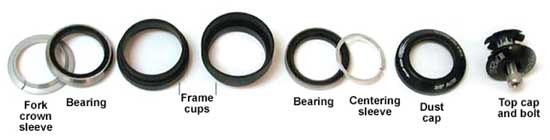
Conventional Threadless HeadsetsThreadless headsets have many of the same features as Threaded Headsets. Bearing cups are pressed into the bike head tube. The bearings, which may be loose ball bearings, retainer ball bearings, or cartridge bearings, sit above and below the pressed races. The steering column has no threading. The top race uses an internal centering sleeve on the column to maintain alignment to the bearing cup. Pressure is applied to the top race from the stem. Threadless Headsets must use a compatible stem that matches the steering column diameter. The stem binds to the outside of the column, and holds the top race in adjustment. The threadless standards are 1-inch and 1-1/8 inch diameter steering column. For more on conventional threadless headset including the various standards see Threadless Headsets. |
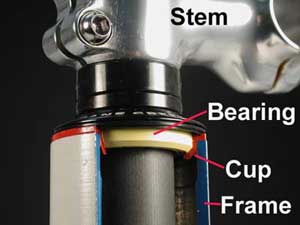
Low Profile, Zero Stack, Integrated with Cups, Internal
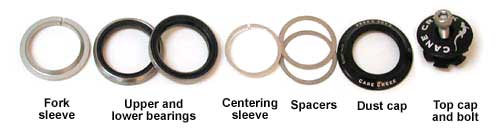
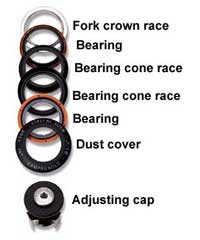
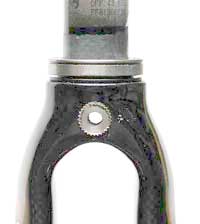
Headset and Semi-Integrated types This type of headset system has, unfortunately, several names. Cane Creek® uses ZS or Zero Stack, while FSA® uses the Orbit Z series. The low-profile, zero-stack, integrated-with-cups, semi-integrated, or internal-headset systems use pressed frame cups that act as a holder for the bearings. The cups have a flange, or lip, and sit adjacent to the outer edge of the top and bottom of the head tube. The head tube is a relatively large outside diameter, approximately 50mm, and cups allow the bearings to sit flush or even inside the head tube. The headset bearings sit "internally" to the top and bottom of the head tube. Some models use a cup that holds a cartridge bearing. The cartridge bearing is a slip fit into the cups. The cups act as a bearing holder and do not take bearing movement or wear directly. Other types have the cartridge bearing and cup/holder as a unit. These are simply replaced as a unit when it is worn out. Still another version of this type uses a cup and cone system with caged ball bearings, similar to the conventional threadless headsets. Additionally, the depth of insertion into the head tube will vary between brands and type. If the bike was designed for a shallow cup, a deeper cup will not properly fit. This lack of consensus in depth makes reaming the inside of the head tube problematic. Below is a picture of the system using bearing cups, cone, and caged
ball bearings, similar to conventional threadless headsets. Generally,
these are considered less expensive headsets. |
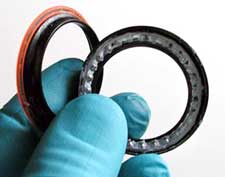
Integrated- Angular Contact System (without cups)
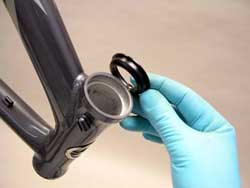
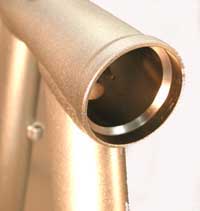
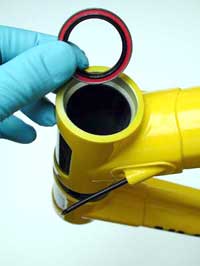
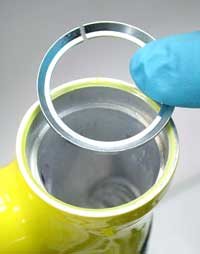
The frame below uses pressed inserts or rings for the angular contact.
Notice the split in the ring. These press in with only hand pressure
against the machined relief in the frame. |
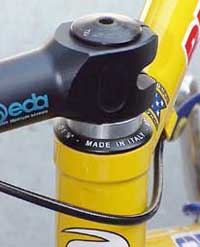
Campagnolo® HiddensetThe Campagnolo® Hiddenset is a proprietary design, and is basically an integrated-angular contact type without cups. The frame must be compatible with this design for this headset to be used. The bearings cone races do not press into the frame. The frame has a specially machined head tube to accept the bearings. However, this standard is not interchangeable with the Integrated System described above. Adjustment is similar to a conventional threadless headset. |
|
Microtech® The Mircrotech® headset system is a proprietary integrated system. The frame head tube is machined specifically for the bearing. There is no angular contact in the frame for the bearing, but rather a square edge is recessed below the top and bottom face. The bearings are a press fit inside the frame and sit on the machined edge. Bearing alignment then references the internal machining, not the top and bottom faces. The lower bearing is also a press fit onto the steering column. The 1-1/8-inch forks use a bearing with an outside diameter of 42mm. Bearing adjustment is the same as threadless systems.
|
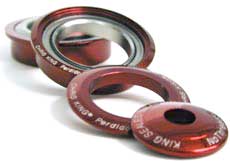
Perdido®The Perdido® headset is a type of low-profile system, but uses different tolerances. The Perdido® system uses pressed cups into the frame head tube. The bearings are fitted into the cups, and are not a simple slip fit like some of the low profile systems. The Perdido® standard requires a very specific head tube inside diameter. The outside diameter of the Perdido® pressed race is 44.5mm, and the recommended inside diameter of the head tube is 44.4mm. The low profile pressed cups use a 44mm OD. This means a bike designed for Low Profile (zero stack) is not directly compatible with the Perdido® system without first reaming. A bicycle made for the Perdido® can only use Perdido®, it cannot use the Low Profile types. |
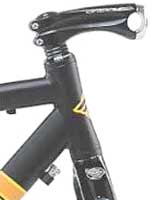
Columbus® Type HeadsetThe Columbus type headset uses a cartridge bearing holding-cup that is pressed into the frame. The frame has no special seat machined inside the head tube. The frame head tube has an outside diameter of 45mm and a machined inside diameter of approximately 39.9mm. A cup of 45mm outside diameter is pressed into the frame. The cartridge bearings sit above and below the frame in these cups. The bearings are nominally 41.5mm outside diameter and are a slip-fit into the cups. The bearing seat of the cups is 36 degrees. This headset allows the "image" of an integrated system by matching the head tube diameter with the cup outside diameter. The Columbus®-type headsets are not interchangeable with other types. Cups are typically painted with the frame, which assists to hide their appearance on the bike. Adjustment is similar to threadless headsets. |
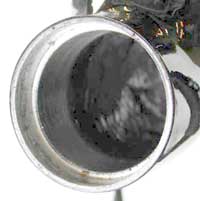
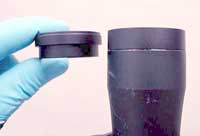
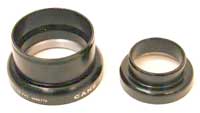
The Onepointfive Standard®The Onepointfive Standard® uses a 1.5-inch diameter (38.1mm) steering column. The head tube inside diameter is approximately 49.6mm. The headsets are conventional threadless types, and but are simply quite large. The adjustment procedure is the same as threadless headsets. Below is a frame cup from the Onepointfive standard next to a 1-1/8-inch standard frame cup. |
|
Headset Standards Summary The various headset standards are outlined in the table below. An "interference fit" is also called a "press fit", where the head tube is smaller than the cup/bearing. The cup is pressed into the head tube with force. A "slip fit" allows the bearing to be installed and removed by hand, with no pressing required. In a slip fit, the outside diameter (OD) of the bearing is smaller than the inside diameter (ID) of the frame. |
| FRAME HEADTUBE ID | BEARING or PRESS CUP OD | Interference or Slip Fit | DESCRIPTON |
| 29.8mm to 29.9mm | 30.0mm | Interference fit | Conventional JIS standard for 1-inch steering column, threaded and threadless |
| 30.0mm to 30.1mm | 30.2mm | Interference fit | Conventional "Euro" standard for 1-inch steering column,
conventional threaded and threadless Interference fit |
| 33.8mm to 33.9mm | 34.0mm | Interference fit | Conventional 1-1/8 inch for threadless and
threaded Interference fit |
| 36.8mm to 36.9mm | 37mm | Interference fit | Conventional 1-1/4 inch for threaded and threadless |
| 38.55mm to 38.6mm | 38.5mm | Slip fit | Integrated-angular contact 1-inch steering column 36 x 36 degree contact |
| 41.05 to 41.1mm | 41mm | Slip fit | Integrated-angular contact 1-1/8 inch steering column 36 x 45 degree contact "IS" or "Cane Creek® types |
| 41.3mm | 41.4mm | Interference fit | Low Profile 1-1/8" steering column, with head tube outside diameter nominally 47mm Frame has no angular contact. |
| 41.55 to 41.6mm | 41.5mm | Slip fit | Integrated-angular contact 36 x36 degree contact TH Industries® ED-36 type |
| 41.85 to 41.9mm | 41.8mm | Slip fit | Integrated-angular contact 45 x 45 degree contact Campagnolo® Hiddenset standard |
| 41.9 to 42mm | 42mm | Interference fit | Microtech® Integrated- non-angular contact Frame has no angular contact. |
| 43.9mm | 44mm | Interference fit | Low Profile for 1-1/8 inch steering column Cartridge bearing types use slip fit into pressed cup. |
| 44.05mm to 44.1mm | 44mm | Slip fit | Integrated-angular contact 1-1/8" steering column 36 x 36 degree contact |
| 49.6mm | 49.7mm | Interference fit | Onepointfive® Standard Oversized threadless type |
| Information and photos are courtesy of Park Tool. Visit their site at ParkTool.Com |
| 100% Satisfaction Guaranteed
At Branford Bike we want you to be happy and satisfied with everything you purchase from us. We understand that sometimes you will need to return a product because it was not quite what you wanted. You may return anything you purchase from us within 60 days and unused, for an immediate exchange or refund. |
| Click on the underlined text to go to the... |
|
Page 12 Park Seat Post and Pedal Tools |
Headsets Table of Contents |
Branford Bike Catalog Main Table of Contents |
Page 14 Working with Threaded Headsets |
|
Branford Bike Catalog Index Quickly find an item or see everything that is in our catalog. |
|
Order Online via our Secure Order Form and receive FREE expedited processing with email confirmations.
Our Secure Order Form is easy to use. Simply fill in the boxes as you would for a traditional paper catalog
order form.
|
|
Branford Bike Online Catalog - Archival Edition brought to you by the former owner of Branford Bike, Tim Brockett via his personal web site, TimsLife.Com |
|
This is an archival edition of the Branford Bike web site from February 2006. Complete with product photos, prices, how to articles and technical specifications it is a treasure trove of accurate, detailed and historical information. In July of 2006 Branford Bike was incinerated by a huge forest fire. No one was hurt but the inventory and buildings were completely destroyed. I witnessed the fire and stayed until the trees were burning in my driveway. At that point I hiked from Branford Bike, through the smoke and embers, down the mountain to my Jeep 3 miles away. I took photos and wrote about the harrowing experience so everyone could see what I saw. My insurance was generous and I later rebuilt my home and started another business selling books. Read the story here. Branford Bike was a huge part of my life for over 30 years; June 1976 to July 2006. I enjoyed those years tremendously and Branford Bike was often a labor of love. I hope you enjoy browsing through the archival catalog. If your visit brings back pleasant memories please share them with me via e-mail at timbrockett@gmail.com . If you find any printed Branford Bike catalogs, advertisments or flyers please scan them as a PDF and email. Or you may mail them via US Post to Tim Brockett, PO Box 1711, Emigrant, MT 59027. Eventually I will post them in a Memorabilia catalog section. Many Thanks and Best Wishes, Tim Brockett |
| Go to our Secure Ordering Page |
|
For more information, call: (203) 488-0482 Our phone hours are: Monday, Wednesday & Friday, 12 noon - 3 pm Mountain Time To print this page in Netscape Navigator or Microsoft Explorer: |