Search My Journal

|
|
Search My Journal
|
|
Travel and Adventure Spelunking in Minnetonka Cave |

The same warm, shallow sea waters that created the limestone layers I visited yesterday at Rick's Spring in Logan Canyon also helped to form Minnetonka cave in the Bear River mountain range. 350 million years ago most of western America was covered with a warm, sub-tropical sea. Shell bearing creatures were everywhere. As they died, their calcium carbonate shells fell to the bottom, rotted and formed a thick layer of limey mud. Over several million more years the mud was buried and eventually turned into limestone. About 50 to 80 million years ago the Rocky Mountains started to form. The earth's surface pushed upwards and sideways. As I saw at Rick's Spring, the limestone layers curved upward and then started to crack along the crest of the curve like a brittle piece of plastic.

At the top of the crested layer of limestone, cracks or fractures in the rock abounded. In the past 50 to 80 million years rainwater mixed with soil, air and decaying plants, followed the cracks and slowly dissolved the limestone. Small cracks grew larger and soon tiny streams flowed between the rocks. At the same time the earth's crust was pushing upwards. The water flowed towards the lowest point and ate into ever lower layers of limestone. As the water level dropped, large boulders fell from the upper limestone layers. Today they litter the surface of the cave.

As the earth's crust continued to push upwards, the streams inside Minnetonka cave drained through the floor in search of a lower level. Rain water still followed small cracks or fissures in the cave ceiling while dissolving surrounding limestone. As rain water dripped from the ceiling it deposited dissolved limestone on the cave floor below. Stalagmites sprouted from the floor when slowly dripping rain water evaporated and left behind a small layer of calcium carbonate. Stalactites formed when the dripping rain water evaporated before it reached the cave floor. Interestingly stalactites are hollow like a soda straw while stalagmites are always solid.
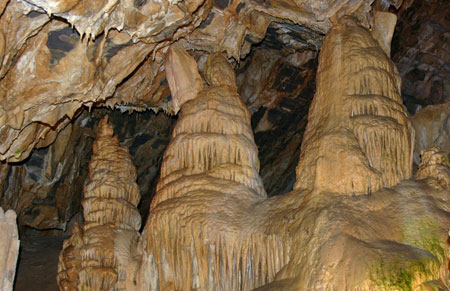
Eventually a stalagmite and a stalactite will connect. They grow slowly and it can take thousands of years before the connect.
Note how the center stalagimite appears to have two heads. A few thousand years ago an earthquake shifted the first head by a few inches. Since then a new one has grown in place will the old one appears to sprout from his shoulder.
Tiny, inch long stalactites are slowly growing from the cave ceiling in front of the two headed stalagmite.

The boulders that fell from the roof of the Minnetonka cave as the water level dropped, litter the cave floor. Dripping rainwater containing calcium carbonate has coated many of the boulders and turned them into fanciful shapes. Other dissolved minerals like iron and manganese lend bright colors to the newly coated boulders. The deposited calcium carbonate is called travertine.
The green in the lower left photo is algae and does not naturally occur in the cave. The electric lights and visitor's exhaled breath allows the algae to grow here.

A newly created travertine deposit |

A pile of boulders becomes a travertine basin |
Minnetonka Cave is located about 12 miles west of Bear Lake off of US 89. Guided tours of Minnetonka cave start in the second week of June and continue until Labor Day. They leave about every half hour, are limited to 30 people and last for about 90 minutes. The cave is cold so I needed a jacket and cap. No facilities are in the cave so it is best to use the bathroom first. The steel handrails are frosty so gloves are a good idea. The cave path is easy to follow and has quite a few steps, 896 total.

Guided tours of Minnetonka Cave |

Dripping travertine eventually forms roof supporting columns |
Click on the "Bookmark and Share" button to:

What do you think of this page? How can it be improved? Do you have questions about its content? Share your thoughts with Tim and other readers by clicking on "Leave a message". I read every message and will respond if you have a question.

Page 2 Exploring Logan Canyon |

Tim's Life Main Table of Contents |

Travel Section Table of Contents |

Page 3 Ferreting for Fossils in Wyoming's High Desert |
 Certified by:


|