Search My Journal

|
|
Search My Journal
|
|
Travel and Adventure Exploring Logan Canyon |
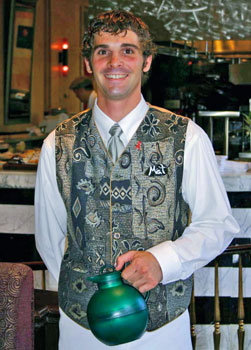
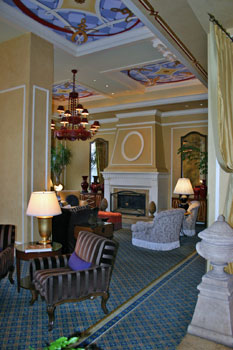
Breakfast was served by Mat in the Hotel Monaco's morning room. I had two eggs over easy, string potato home fries, whole wheat toast and two strips of maple flavored bacon. Chives were sprinkled over the eggs and bacon. It looked so wonderful I almost did not want to eat it. The toast was thick, still moist and delicious with real butter and fresh raspberry jam. The coffee was fresh and and full of flavor. A cold glass of fresh squeezed orange juice topped off one of the best morning meals I have had since I was in Poland last summer. The starched, bright white linen tablecloths and the French inspired decor lent an old world ambiance to a new world, and typically American West, breakfast fare.
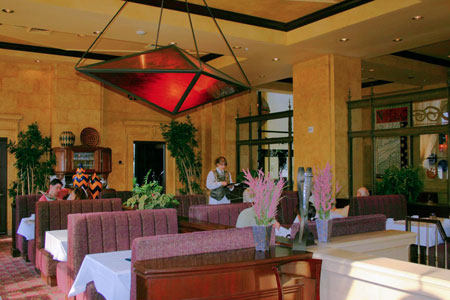
Bambara, the Hotel Monaco Restaurant |
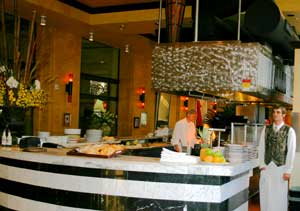
The kitchen at the Hotel Monaco |
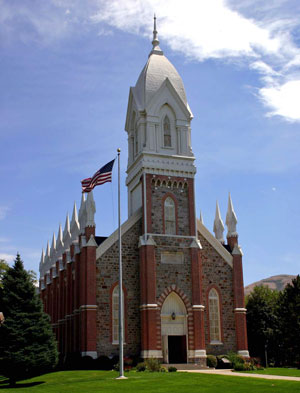
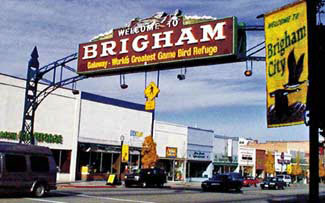
About an hour north of Salt Lake City lies Brigham City and the opening to beautiful Logan canyon. Brigham City is named after Brigham Young, a Mormon leader who brought his people to to a place where they could live and worship as they chose. In 1867 the first blocks of stone were laid for the inspiring Box Elder Tabernacle. Only local rock was used and the timbers came from Logan Canyon. Twenty-three years later the massive church was completed and dedicated. Six short years later a devastating fire gutted the inside of the Tabernacle. Just one year later, in 1897, the building was rebuilt and dedicated again. Today it stands as a testimonial to the perseverance and hard work of the early Mormon settlers. It is still used as a place of worship.

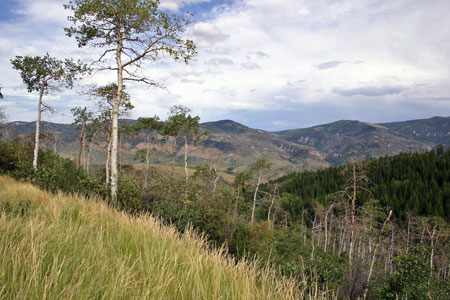
Rocky Mountain canyons are usually carved from rock by running water. The Grand Canyon in Arizona is a good example. Over the course of just 2,000 years the Colorado river eroded away the soft sand and limestones and a huge canyon was formed. The Logan river has carved out the Logan canyon in a similar fashion but it is not quite as deep as the Grand Canyon.
The layers of whitish gray limestone you see in the Rick's spring photo are the remains of millions of dead shell bearing creatures that lived in a shallow, warm tropical sea about 350 million years ago.
Note how the layers are curved. They go up over the bush on the left and then dive down towards the cave like opening to Rick's spring.
About 50 to 80 million years ago the Rocky Mountains were born. The earth's crust in western North America started to push upwards. The curved layers of limestone at Rick's spring were originally flat and covered with warm sea water. As the earth pushed upwards the limestone layers rose, folded and then buckled like a piece of brittle plastic. At the top of the curve is where the limestone started to crack or fracture. Water from rain and the Logan river followed the fractures in the limestone and is the source for the water in Rick's spring.
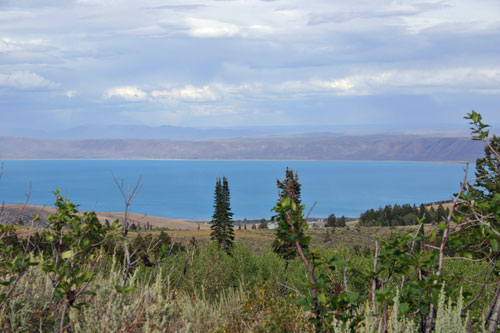
The Logan river leaves the canyon at Brigham City where the elevation is 4,700 feet above sea level. The canyon road follows the river for about 30 miles up the canyon and then it starts to climb the Bear River Range to the 7,800 foot summit. At the peak you can see for 100 miles on a clear day. The turquoise waters of Bear Lake spread for 20 miles in the valley below. In the far distance of the photo on your left, the Wind River range rises above the horizon.
Note how the waters of Bear Lake are turquoise, just like the sea off southern Florida or in the Caribbean. Why? The turquoise color comes from limestone or calcium carbonate that is dissolved in the water from the surrounding rocks. Sub-tropical ocean water is turquoise for the same reason except that the calcium carbonate comes from the rotting shells of dead sea life.
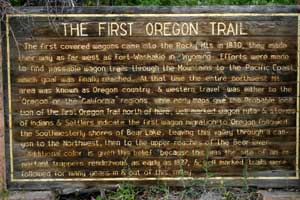
Starting in the 1830's tens of thousands of emigrants headed west in covered wagons to find a better life in the California or Oregon territories. Officially the Oregon trail went north of Bear Lake. Local lore says that well defined wagon tracks were present along the southeasterly shore of Bear Lake. Stories from early settlers and Indians support this claim even though early maps do not. The southeastern shore of Bear Lake is flat and easy to travel. Fish and wildlife are abundant so it would seem like a logical route. Wagon trains continued moving tens of thousands of emigrants west until the trans-continental railroad was completed after the Civil War in 1869.
Click on the "Bookmark and Share" button to:

What do you think of this page? How can it be improved? Do you have questions about its content? Share your thoughts with Tim and other readers by clicking on "Leave a message". I read every message and will respond if you have a question.

Page 1 Samantha, Cierra and Salt Lake City |

Tim's Life Main Table of Contents |

Travel Section Table of Contents |

Page 3 Spelunking in Minnetonka Cave |
 Certified by:


|