Search My Journal

|
|
Search My Journal
|
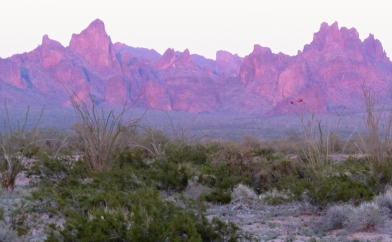
I visited KOFA in 2018 and hiked the Palm Canyon trail. This year the temperature was in the low 80's by noon and a little hot for hiking. I kept busy by cataloging photographs and creating new pages for TimsLife.com. The pages I write assist me with keeping an accurate timeline of my journeys and provide an understanding of how different experiences build upon each other. My life makes more sense when I write about it.
Working while on vacation seemed to conflict but I enjoyed the work I was doing. Does that make a difference I wondered?
I also used the peace and tranquility I found at KOFA to better understand the campgrounds I stayed at this year and the people I met. Most of the folks I spoke with were retirees in their 60's and 70's. They had modest trailers or motor homes and were from northern climates. Snowbirds they are often called. Some came from as far away as Alberta, Canada while others were from nearby northern Arizona. All were escaping the cold and appeared to be living within a modest budget. My own expenses came to about $46.00 per day. That included gas, supplies, campground fees and food.
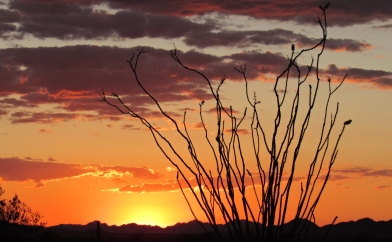
Arizona has spectacular desert sunsets. |
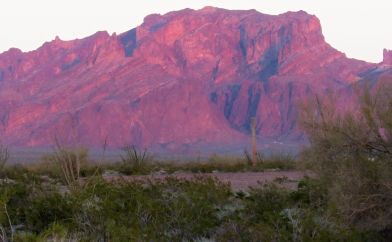
Sunset's glow on Old Smokey Mountain. |
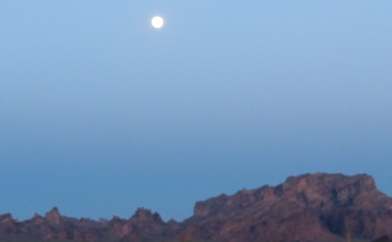
The camping at KOFA is free; you may park a trailer, a motor home or pitch a tent within 100 feet of the road and stay for up to 14 days. Most parks also have a two week limit so snowbirds tend to move around the state on their extended vacation. KOFA is "Dry Camping" which is also called "Boondocking". Basically no services are provided. You have to bring water, provide for sanitation, generate your own electricity, etc. The nearest town is Quartzite, Arizona and is about 30 minutes away. KOFA has some grand mountains and they rise from a large, gently sloping plain that is often windy. In two days I was buffeted by winds from all four directions. RV's often camp along Palm Canyon road on the wind blown desert cobble pavement.
I received a dozen TV stations with my 150 mile range rotor mounted antenna. Several were in Spanish. The Weather channel was most helpful. I could watch TV for four hours and use only 30% of the electricity stored in a single 12 volt car battery. The solar cell on top of the trailer would recharge the battery in just three hours the next morning.
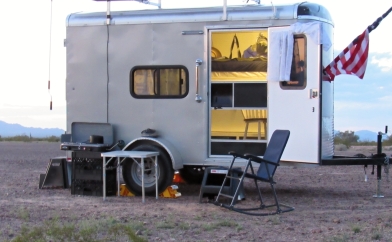
My wind blown trailer home at KOFA. |
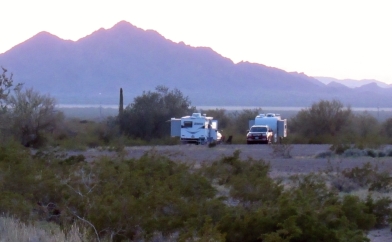
Boondockers in the KOFA desert. |
This was the maiden voyage for my cargo trailer converted to an RV. I anticipated boondocking but KOFA was the first test. The roof top solar panel combined with a 50 amp/hour 12 volt sealed battery provided ample electricity to run the LED lights, TV, computer and water pump. I had a small leak in a water pump hose and that was easy to fix. My eight gallon fresh water tank was adequate for my three day stay. A propane catalytic heater would have been nice as the night time temperatures dropped into the 40's Fahrenheit. I dug a deep poop hole in the desert and that worked fine. I had a five gallon solar water bag with a sprinkler attachment for showers. A Wolfwise shower tent provided privacy. My two burner propane stove cooked meals and toasted a bagel for breakfast. Life was comfortable, the neighborhood was agreeable and million dollar views encircled me. Ground fires are allowed but firewood collecting is not. I still had wood from Montana so on the last night I warmed myself for several hours in the cool night air beside a wonderful campfire.
Next year I may add a second solar panel and battery to my electrical system. Then I can add a small refrigerator/freezer to the trailer. Currently I use a 70 quart Coleman ice chest which consumes 10 pounds of ice every three days.
I visited KOFA in 2017 and wrote an article with photos here.
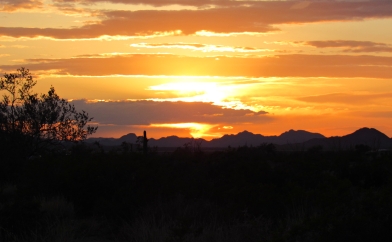
A lovely ending to a wonderful day. |
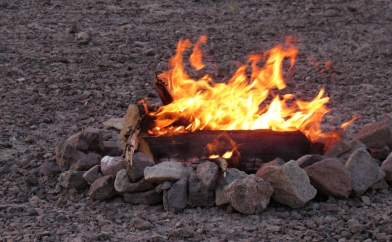
Campfires are good company. |
I departed from KOFA on March 21st, drove north to Quartzite and then east on Interstate 10 to Route 85. I followed Route 85 to Gila Bend, Ajo and then Organ Pipe Cactus National Monument. Organ Pipe sits on the US side of the Mexican border and is ground zero for illegal immigration. Many locals shy away from the subject when questioned and try to depict the criminals as "migrants" that are just passing through. Then they change the subject or are in a hurry to get somewhere.
I camped at Organ Pipe last year and felt safe despite the drugs and criminals that cross the porous border. The Border Patrol is heroic and they continue to do an excellent job of keeping the campground and our country as safe as possible from the scourge of illegal immigration. This year felt different though. There was a tension in the air and I no longer felt safe hiking alone in the desert.
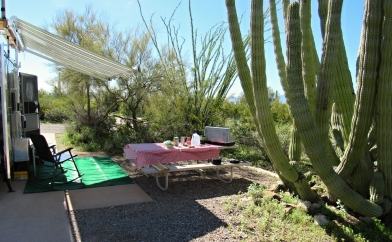
I found a pleasant pull through trailer camping spot that was bounded by the largest Organ Pipe cactus I have ever seen. The campground was half empty and I soon learned why.
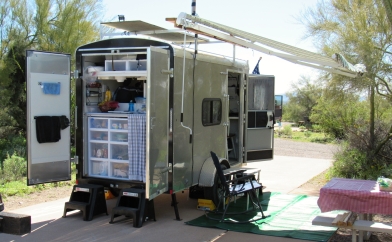
Organ Pipe Cactus trailer campsite. |
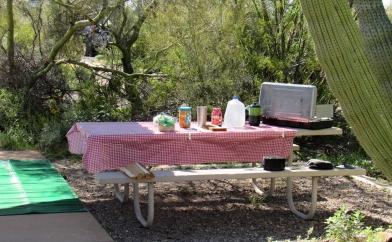
A classic picnic table arrangement. |
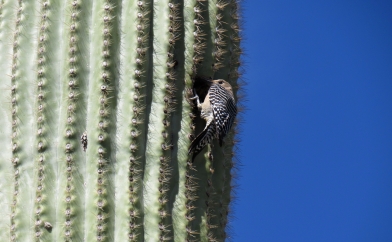
Much to the surprise of many campers Organ Pipe officials decided to go to a campsite reservation system this year. In previous years campers found a site and could stay there for up to 14 days. Now they can only stay one night and must get a reservation to stay longer.
Many decades ago the Organ Pipe campground was well designed and built. In 2019 the campground is dated and in serious need of upgrades. The sites are small, do not have electricity, individual water or sewers. The campsite restrooms lack hot water, soap, hand driers or even paper towels. About half of the restrooms have rudimentary solar showers which often dispense cold water and then just in short bursts. Military showers are the norm.
It appears that many campers left after one night because they did not want to hassle with reservations for an outdated campground. I tried to book online but the site was down. So I called, got put on hold for 15 minutes and then finally talked to a woman who was able to enter my reservation. She lacked a calender so I had to walk her through days and dates.
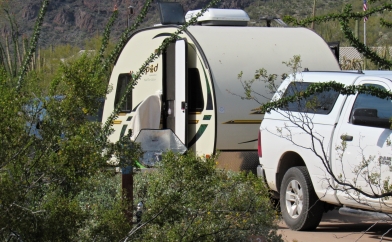
Camp trailers come in all shapes and sizes. |
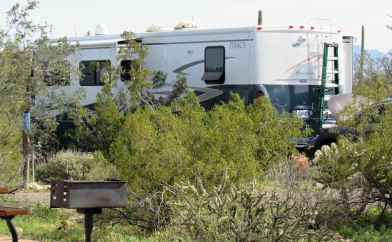
White is the dominant color; swirls seem to be required. |
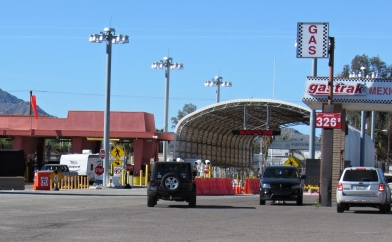
Organ Pipe Cactus National Monument is ground zero for illegal immigration to America. Mexico Highway 2 runs parallel to the US Border which is often just a stone's throw away. The new game for illegals is to bring a child and claim you are a family fleeing political persecution. US Immigration law gives these folks a free pass to America when they ask for political asylum. Illegals with children no longer need to sneak through the desert at night. They simply walk across the border, child in hand, and wait for the US Border Patrol to detain them, feed them and give them a bus ticket if they have relatives in the USA.
While I was getting supplies at the gas station convenience store a family of five brazenly walked across the US border at 10 AM in broad daylight. An ICE agent noisily hovered overhead in a helicopter watching them cross. When they made it to the US side, he landed in the gas station parking lot and arrested the family. None of the locals paid any attention so I am guessing this is a frequent occurrence. That weekend almost 400 illegal immigrants walked across the border into Organ Pipe Monument and waited for ICE to pick them up.
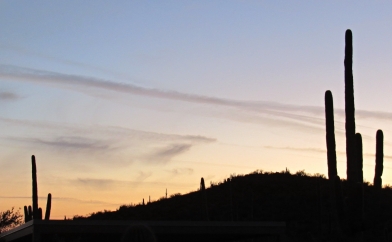
Classic Arizona desert sunset. Criminals make desert drug drops and pickups at night. |
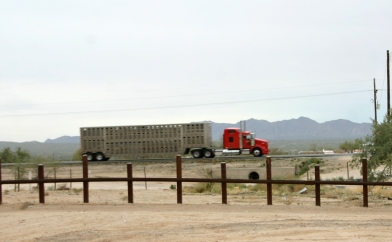
Mexico Highway 2 west of Lukeville. A major crossing point for illegals. |
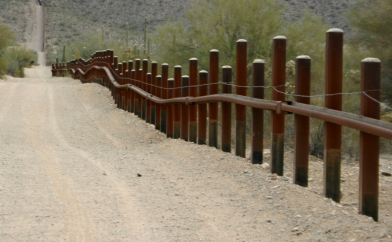
Twenty years ago or so a car barrier was built along the US border with Mexico. It was only designed to keep vehicles laden with drugs and illegals from crossing the border. Walking across was not an issue because of the vast open desert that had to be crossed and the high probability of getting caught or perishing from thirst. The car barrier is constructed of cement filled steel posts with a single old railroad rail for a cross member. It is an effective barrier for vehicles but it is quite easy for pedestrians to duck under and walk into America. Charter buses often pull off Mexico Highway 2 and discharge their passengers next to the barrier. In just a few minutes the entire busload of illegals can squeeze under the single rail and be on US soil. With children in hand they wait for the Border Patrol to pick them up so they can claim political asylum.
The nighttime desert is full of danger. Criminals sneak across the border with backpacks laden with illegal drugs. Sometimes they place ramps on the single railroad rail fence and drive ATV's up and over. They employ GPS to drop drugs and sometimes gang members at specific points in the desert. Then under cover of darkness they quickly retreat to the safety of Mexico. The GPS information is relayed to partners on the US side who retreive the drugs and forward them to criminal gangs for distribution throughout the US. The Border Patrol intercepts more than a few of the couriers and their deadly drugs via inland traffic stops. The drug supply is huge though and some still get through to poison and kill Americans from coast to coast. An enhanced barrier that is difficult to cross would greatly reduce traffic and drug flow into America through Organ Pipe Cactus National Monument.
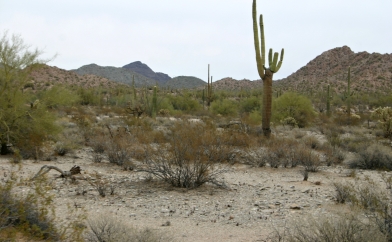
A hot, deadly desert awaits illegals who arrive without children and must walk for endless miles. |
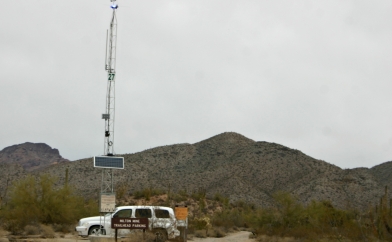
Emergency beacons with solar powered radios dot the forbidding desert. |
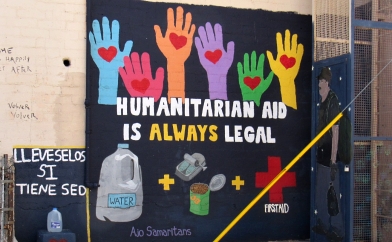
In the small town of Ajo which is about 40 miles north of Organ Pipe Cactus Monument I came across several wall murals that portrayed illegals as victims or simply people migrating to a better life in America. One mural regarding military cooperation with the local Indian nation, the O'odhams, appeared to be anti-Semitic. I hope the views expressed via the murals are not shared by everyone in Ajo. The town is in sad shape having lost it's major employer when the copper mine closed in 1985. Some of the buildings are abandoned and falling down. Many businesses and homes have bars on their windows. There are a few historic buildings and the town has a pretty Spanish Colonial plaza that I took some photos of. It is sad to see so much decay and the embracement of leftist politics. The two seem to go hand in hand throughout the world.
One border patrol agent recommended that I carry a gun if I went hiking in the desert at Organ Pipe Cactus Monument. "The desert is a dangerous place and if you are hiking alone you should carry a gun" he stated.
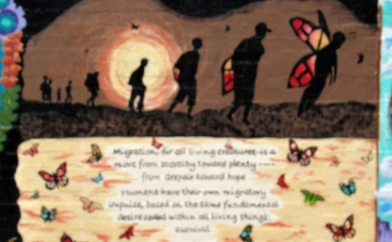
Illegals are compared to butterflies harmlessly migrating across the border. |
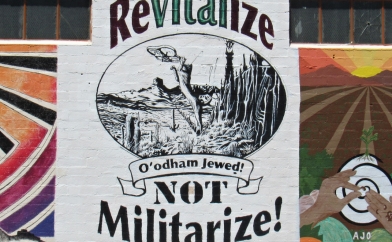
O'odham Jewed - Anti-Semitism in Ajo? O'odham is the local Indian tribe. |
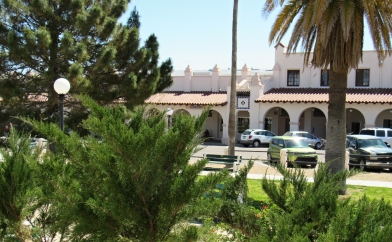
Historic Spanish Colonial Plaza near the south end of Ajo. |
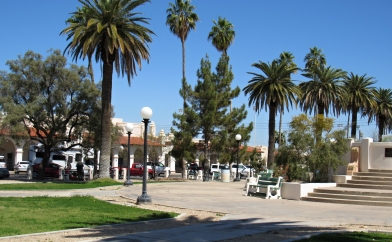
Graceful Palms line the plaza's borders. A bandstand sits at one end. |
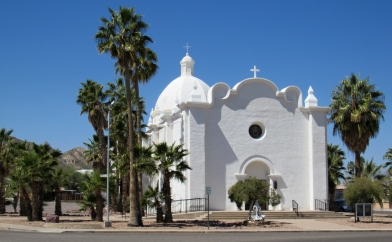
A lovely Catholic church across the street from the plaza. |
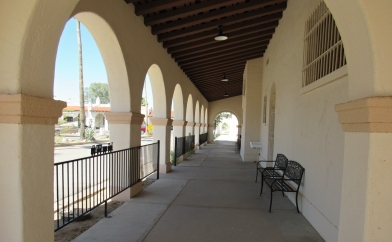
The old railroad station sits at the far end of the plaza. |
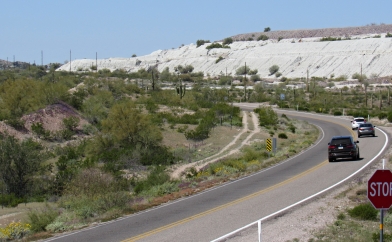
A huge mountain of mine tailings is visible when entering Ajo from the south. |
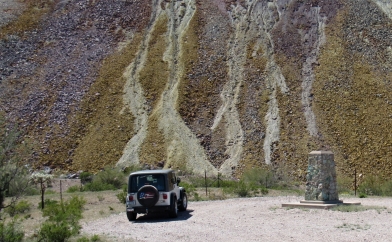
Massive scrap rock piles dwarf my Jeep and the historical monument. |
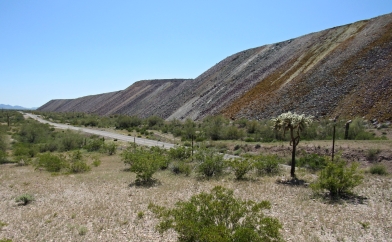
On March 27th I left Organ Pipe Cactus National Monument and headed across the O'odham Indian Reservation towards Picacho Peak State Park. I traveled over two lane remote back roads that wound through the desert garden landscape. Flowers bloomed profusely right up to the edge of the asphalt. It was a magical drive with every bend in the road providing stupendous views of nature's beauty. I stopped for awhile and walked through nature's lovely garden.
A few hours later I arrived in Picacho Peak Park for five days of rest and relaxation.
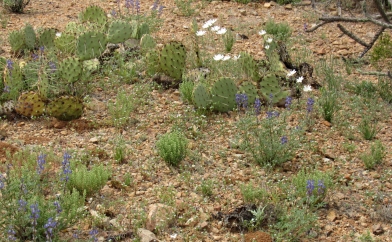
Desert garden landscape. |
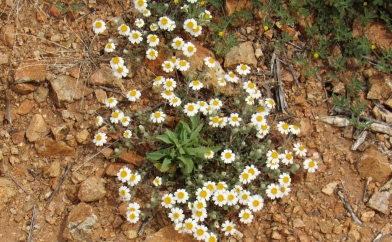
Tiny daisy like desert flowers. |
Click on the "Bookmark and Share" button to:

What do you think of this page? How can it be improved? Do you have questions about its content? Share your thoughts with Tim and other readers by clicking on "Leave a message". I read every message and will respond if you have a question.

Page 3 2019 Arizona Vacation |

Tim's Life Main Table of Contents |

Travel Table of Contents |

Page 5 Work and Retirement |
 Certified by:


|