 Search My Journal

|
|
Search My Journal
|
|
Travel and Adventure Buffalo Bill Historical Center |
| A word from our $ponsor, Ads by Google |
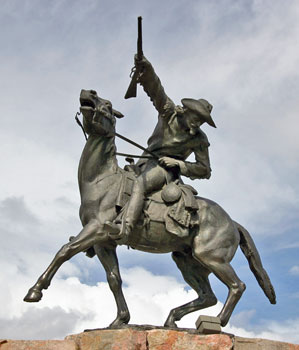
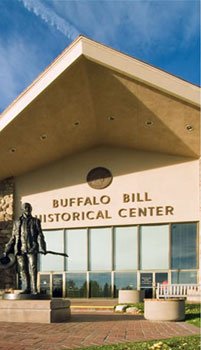
James Michener once called the Buffalo Bill Historical Center "The Smithsonian of the west". Perhaps he overstated a little but the Buffalo Bill Historical Center is an amazing place. Five museums are tucked under one roof in a spacious, modern building in Cody, Wyoming. The Whitney Gallery of Western Art houses a thorough collection of paintings, sculptures and prints that detail impressions of the West from the early 1800s to the present. The Plains Indian Museum is one of the largest collections of Northern Plains Indian art and artifacts in America. The Cody Firearms Museum contains over 5,000 guns and other weapons from Europe and America that date back to the 16th century. The Draper Museum of Natural History even handedly deals with the relationships between humans and nature in the greater Yellowstone ecosystem. Finally, The Buffalo Bill Museum traces the life and times of Cody's most famous resident and pioneer culture in the American West.
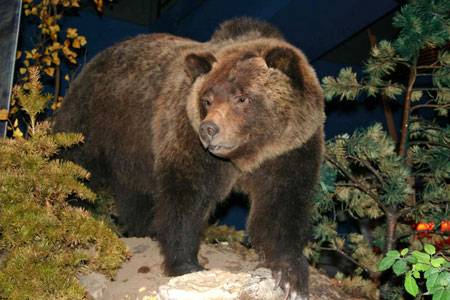
Grizzly Bear from Yellowstone |
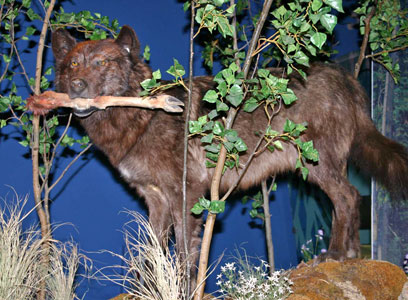
A Timber Wolf chews on an Elk leg |
| A word from our $ponsor, Ads by Google |
Ivisited the Draper Museum of Natural History first and was pleasantly surprised. Too often the relationship between man and his environment is portrayed as exploitative and destructive. The Draper Museum treats mans relationship with the greater Yellowstone ecosystem with fairness and balance. Stuffed animals were numerous and were often road kill. I was fascinated by the details of the now harmless Grizzly bear and Timber Wolf. Look at the claws on the Grizzly pictured above.
Re-introduction of Wolves to Yellowstone created much controversy. Visitors were asked to write down what they thought and submit it. Both sides of the argument were presented on a bulletin board from museum attendee's written views.
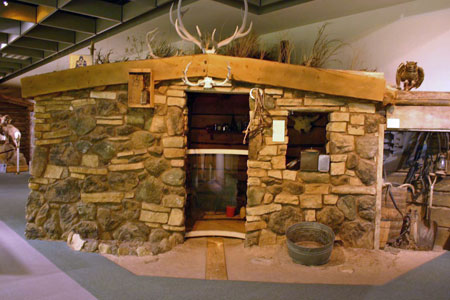
Man was treated as part of the environment and the displays focused on understanding and improving that relationship. Irrigation and farming were not seen as completely incompatible with a naturally dry western climate. Emphasis was placed on growing crops that required less water but were still profitable. Oil drilling was treated with respect and understanding; the benefits energy brought to man were highlighted.
The bird displays featured many stuffed birds posed in their natural environment along with recordings of their songs. Mixed in with the wolf howls and other natural sounds it was quite a cacophony. Regardless I found the Draper Museum enjoyable and refreshing for its balanced treatment of man and his environment.
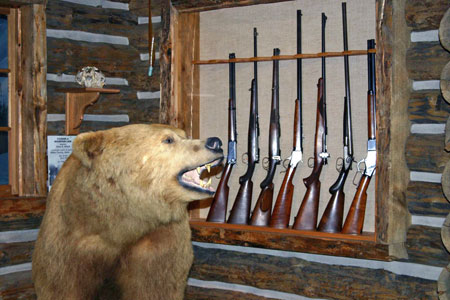
After lunch and a delicious double latte I meandered over to the Cody Firearms Museum. I was born and raised in Branford, Connecticut so I never owned a gun nor had I ever been hunting. I do not like the sight of blood, mine, another person or an animals. None the less, I have developed a respect for guns over the years and I am interested in how guns often changed the course of history. The Cody Firearms Museum treated the subject of guns even handedly and paid no attention to political correctness.
In the American West guns are a tool much like a hammer or a hoe. They help to get food, protect against varmints and the occasional dangerous animal. In the pioneer west they also protected home and family from dangerous humans; both Indian and outlaw.
Sport hunters make up a large percentage of gun owners and the Museum depicted them well.
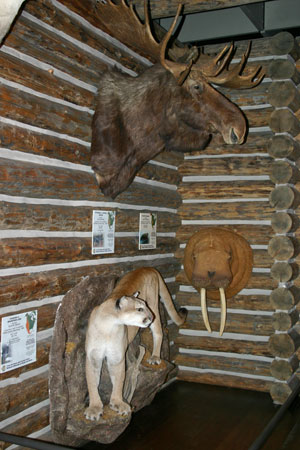
A Moose, Mountain Lion and Arctic Walrus |
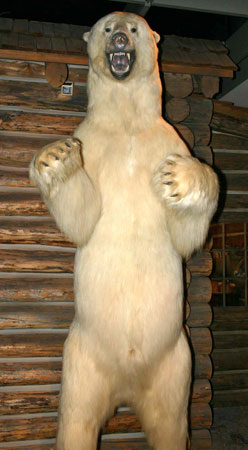
Polar Bear from north of the Arctic Circle |
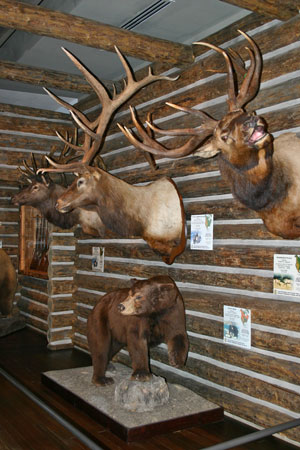
Elk heads and a full Black Bear adorn a hunter's log cabin |
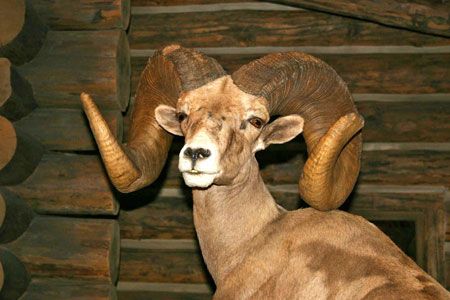
All of the beautifully preserved animals were donated by various hunters or their spouses. No animals were shot specifically for the Museum. Like the grizzly bear in the Natural History museum I marveled at the delicate features I could see in the various stuffed animals without putting myself at grave risk. Polar Bears are ferocious looking, but present no danger, when they are stuffed.
The Cody Firearm Museum orders their collection of guns by time and by manufacturer. I enjoyed the time sequence best. It allowed me to view the evolution of guns in America from muzzle loading rifles in the Revolutionary war to the lightweight automatic weapons of the first Gulf war.
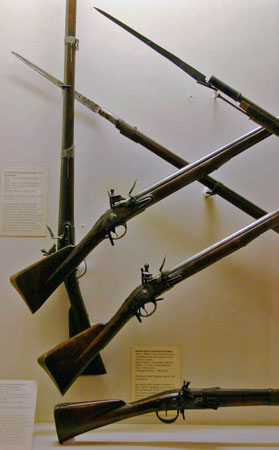
Flint Lock muskets with bayonets circa 1764 |
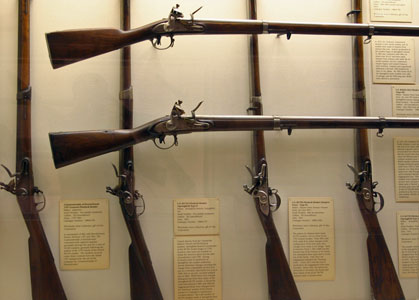
Single shot Flint Locket Muskets, circa 1794 to 1805 |
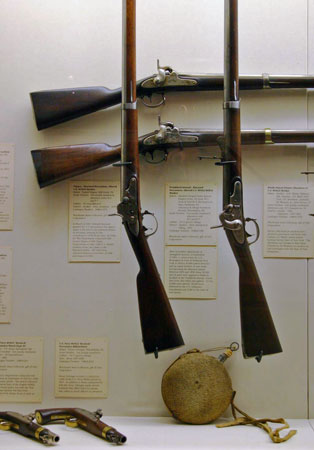
In the 1850's two innovations led to greater accuracy and lethality. Rifle barrels were traditionally smooth and were eventually fouled by the round, lead balls used as ammunition. Around 1850 some gun makers experimented with rifling the barrel; that is cutting a few helical threads into the inside of the barrel to keep it cleaner. At the same time a Frenchman was experimenting with an umbrella shaped lead projectile. The front had a cone like nose while the back was umbrella shaped. Powder was still placed in the gun barrel and tapped down. Then the umbrella pellet was inserted instead of the older, spherical lead ball. When the powder was ignited by striking a piece of flint against steel, the umbrella end would expand to match the inner diameter of the gun barrel. The rifling of the barrel caused the cone shaped projectile to spin and lent the gun greater accuracy. Other gun manufacturers were experimenting with cartridges that contained black powder and a lead projectile; the precursor to the modern bullet.

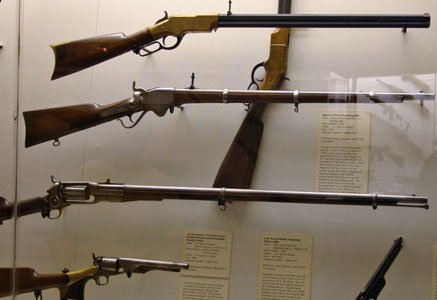
The development of modern bullets added accuracy and power to the traditional muzzle loading musket. Unfortunately the tactics of warfare were slow to catch up with technology. In the beginning of our Civil War generals followed the teachings of Napoleon. He taught that troops should line up in rows several deep and pummel the enemy with alternate volleys of musket fire. While one row shot another could load. Muskets with round balls were notoriously inaccurate so troops were urged to get as close as possible to the enemy and then overwhelm them with successive volleys. Napoleon's advice when combined with rifles that were more powerful and accurate than muskets proved deadly. Thousands of troops on both sides were immediately wounded or killed when the first shots were fired.
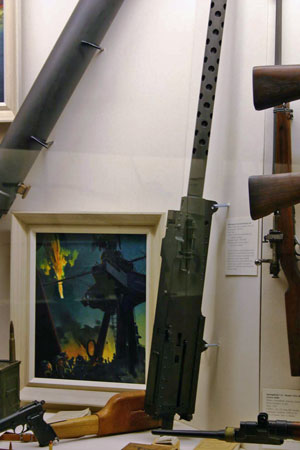
World War II saw the advent of powerful automatic weapons that could bring down enemy aircraft. The 50 caliber machine gun was widely used aboard Navy warships in the Pacific and was responsible for destroying many Japanese Zero fighter planes. Several automatic weapons were used by ground troops but the M1 carbine was the most popular choice. In the photo below several WW II automatic weapons are shown. The one with a wire frame, folding stock, was used by paratroopers.
Many Americans still used the M1 in Vietnam. They claimed that the M16, a newer automatic rifle, was not as accurate in the dense jungle. Some Marines were known to carry both.
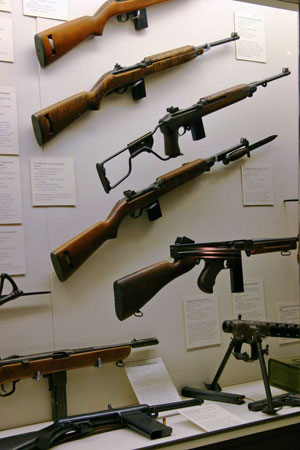
Automatic weapons from WW II |
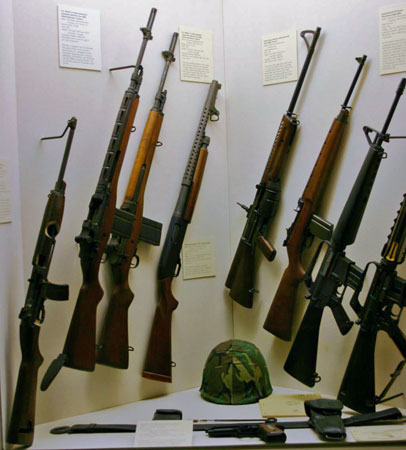
Vietnam and Gulf War weapons |
What do you think of this page? How can it be improved? Do you have questions about its content? Share your thoughts with Tim and other readers by clicking on "Leave a message". I read every message and will respond if you have a question.
| A word from our $ponsor, Ads by Google |

Page 6 Wyoming's Wind River Canyon |

Tim's Life Main Table of Contents |

Page 8 On The Road To Yellowstone Lake |
 Certified by:


|