 Search My Journal

|
|
Search My Journal
|
|
Branford, Connecticut 100 Years of Parks and Recreation |
| A word from our $ponsor, Ads by Google |

About 100 years the Parker family gave the people of Branford 12 acres of shorefront property for their pleasure and enjoyment forever. The park was modeled after an English Garden and has changed little since it first opened to the public. Some areas were left with naturally occurring trees and shrubs while others were planted with a grassy lawn. One large curving beach and a smaller, rock sculpted beach were filled with sand. A playground with swing sets, seesaws, a slide and spring mounted animals was built for children. Picnic tables dotted the grassy lawns that curved around rocky outcrops and over a broad hill. Fireplaces and outdoor metal grills accompanied each picnic table. A large, graveled parking area accommodated about 100 cars. Outdoor showers, enclosed bathhouses with changing rooms and flush toilets added extra convenience. Thousands of Branford residents visit Parker Memorial Park every year for family picnics, sunbathing, swimming and fishing. The park is well maintained, has ample trash cans and is almost always spotlessly clean.
| A word from our $ponsor, Ads by Google |

Parker Memorial Park is a creation of man working with Mother Nature. Man added sand to the beach and built the seawall to prevent the salt water waves from washing away the broad, grassy lawn. Nature created the rocky hill, outcroppings and massive oak trees. It was man who trimmed away the underbrush, cut down the weed trees and thus allowed the century old oaks to reach towering heights with fully formed crowns. It was man who built the picnic tables, the fireplaces, the children's playground and park benches that made the park pleasant and useful for people. The idea behind an English garden is that man can work with nature to create something more beautiful, practical and functional than either could on their own. Tens of thousands of visitors draw pleasure yearly from this particular garden called Parker Memorial Park in Branford, Connecticut.
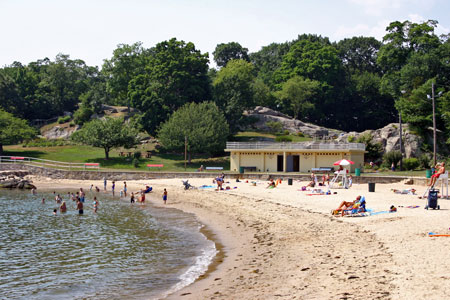
My parents often walked to Parker Memorial Park with my five brothers and I on Sunday afternoon when church was over. My older brother Billy usually lead the way on his newspaper delivering bicycle. My dad pulled a wagon with a picnic basket full of plastic dishes, hot dogs, hamburgers, Kool-Aid, potato chips and macaroni salad that my mom made. Our clan of eight formed a small parade as we joined with many other families walking the same mile and a half route to sea shore park. We always found a table on the hill and next to an open fireplace where we cooked our Sunday picnic meal. After eating we would play on the swings for awhile until my mom said it was ok to go swimming. Then we ran as fast as we could to the waiting beach and warm water. The rest of the afternoon was spent building sand castles, digging moats and playing in the water. When the sun started to hang low in the western sky we ate our supper, packed our wagon and headed home. Sometimes my oldest brother, Billy, would carry either me or my younger brother Terry, in his bike newspaper basket on his fat tired bike.


Around the turn of the 19th century trolleys connected New Haven with shoreline towns. Tracks ran down the center of Main street in Branford and along the shore. After World War II the trolleys fell into disuse and the tracks were abandoned. In the 1970's local Boy Scouts lead by Bob Baker and Frank Twohill, built a trail along the old trolley right of way from Pine Orchard to Stony Creek. They cleared the track bed, spread fine gravel on it and built bridges and walkways with the old trolley rails and donated steel mesh, rock sorting grids, from the local trap rock quarry.

In 1998 the Town of Branford and local volunteers revitalized the old trolley trail. Seed money came from the state Department of Motor Vehicles. A structural engineer was called in, heavy construction companies followed and pre stressed concrete sections were ordered. A new, Pirates of the Caribbean nautical style bridge with plastic park benches at is peak, was constructed over the old trolley bridge footings. Billboards were placed at either end to inform all visitors of the volunteers responsible for this whimsical and entertaining structure.

Dogs are allowed to run wild in this park and owners are given free poop bags encouraged to clean up after them. You must take the bag of poop with you though for no trash cans are provided. |

Eight foot billboards list like movie credits, all the folks who made this production possible. |

Visitors are reminded not to collect or eat the shellfish from the polluted water and muds of Long Island Sound. |

The Trolley Trail is used frequently by walkers, runners and dog owners although it is nowhere near as popular a place as Parker Memorial Park. Children are rarely seen here. Dogs are allowed to run free and their owners do not always clean up after them so you have to watch where you walk. There are no picnic tables, bathrooms, wide grassy lawns or pleasantly groomed areas around grand oak trees. Parking is limited to spots that are often wet and muddy and 1/4 of a mile away from the main attraction. Graffiti covers bridge abutments, rocks and electrical boxes. Poison Ivy wraps its vines around many of the overgrown shrubs and prickly wild rose bushes. Trash often litters the ground as no refuse containers or collection is provided. Swimming is not allowed and the only spots to rest are the two plastic park benches on top of the whimsical bridge.

Children jumping into the tidal river on hot summer days is now just a memory of a bygone time. |

Litter is common as trash cans are not provided. |
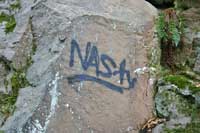
"Nasty" graffiti art adorns ancient, moss covered boulders. |
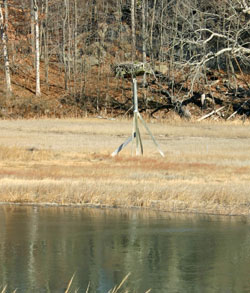
The main and defining feature of the Trolley Trail is not the movie set bridge but rather what you can see from it. From the sole park benches on top of the bridge you can see a pedestal with a platform rising from the salt marsh. An Osprey's nest is perched on top. It is possible to sit on the park bench, focus solely on the nest and contemplate about how beautiful, how pristine this area must have been before man built the railroad, the trolley, invented planes that fly overhead, cars that can be heard in the distance and oil tankers visible on Long Island Sound. How lovely it must have been. So peaceful and quiet. Why did man have to ruin such virgin beauty one might muse. Most Post Modern writers feel the same way. America, they say, was a Garden of Eden, until the white man came. Capitalism, developers and greed destroyed the garden. Many environmentalists agree and believe that man is on the verge of destroying the entire planet via pollution and global warming. Perhaps earth would be better off if man did not exist the most radical environmentalists postulate. The Trolley Trail park appears to be the ideal stage set where one can observe nature and contemplate man's relationship to Mother Earth.
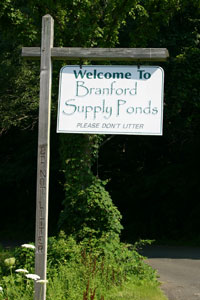
This sign reminds people not to litter; twice. Once nicely on the sign and again with a more demanding tone, engraved on the post. |
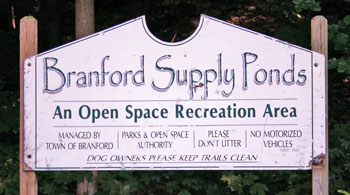
Credits for actors and more requests for good behavior. |
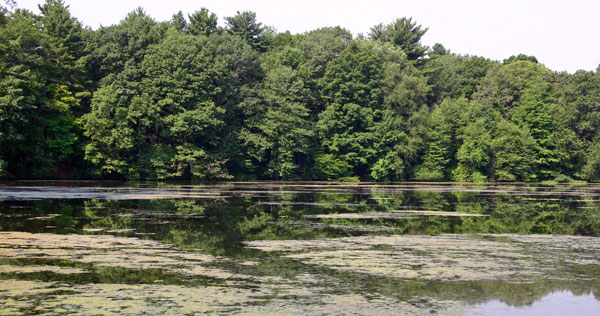
In the late 1960's the Town of Branford, with help from the Federal Government, purchased about 300 acres of forest and 30 acres of adjoining ponds from the New Haven Water Company. It was named Supply Ponds Park but it was never developed like the other parks in town. Some folks wanted a beach but that idea was dismissed when people realized that because federal taxpayer funds were used to purchase the land, the waters would be open to everyone; not just Branford residents. Other people asked for picnic tables, swings and toys for children, spots for day camping, a boat dock and fishing area, toilets and a convenient parking lot. All ideas fell on deaf ears or were simply rejected.

Eventually the Boy Scouts, lead by Frank Twohill and Bob Baker, marked and developed an extensive trail system and built several small bridges across streams. Then, over the course of 25 years, the park fell into neglect. The bridges rotted and were removed or washed away. The well used trails eroded quickly and often grew to 10 feet wide as people walked around puddles and muddy spots. Curiously the response from environmentalists in town government was to take away the trash cans and then admonish people to "Leave No Trace" when they visited the park. A large, 50 car parking lot that used to be the police shooting range, is securely locked and remains unused. On street parking is limited to about 20 automobiles in five small turnouts.

Another way of saying that visitors are not welcome. |

When trash cans are removed, some people leave their trash on the ground. |

A billboard in the distance lists the names of the actors who are responsible for the latest Supply Ponds Park production while a locked display case advises visitors of proper behavior. |

Effort and expense are not spared for rules and regulations while simple spray paint is good enough to mark trails. |

A large 50 plus car parking lot was securely gated and allowed to fill with weeds. A two car pull in was blocked with multi-ton blocks of pink granite and the surrounding trees defaced with "NO" signs. The remaining five small parking areas hold about 20 cars. Bicyclists and walkers have not fared any better. The winding one and a half lane road is poorly maintained and has several curves with limited visibility. Six foot tall roadside weeds in late summer block views of oncoming traffic. Sidewalks are non-existent and not a single bike rack is present at the Supply Ponds park. Facilities are less than Spartan. There is no running water, no toilets, no park benches for the weary, no picnic tables for families, no toys for children and of course no trash cans for refuse. On a brighter note though no one complains about the lack of a beach. The ponds turn chocolate brown after a heavy rain. In the summer thick, smelly and bug infested mats of alga cover the murky brown, tepid water.

When I was a teenager the only signs around the Supply Ponds were "No Trespassing" ones left from the days when the New Haven Water company owned the property. In the last decade signs have sprouted around the park like toadstools after a summer rain. Curiously, almost all are aimed at improving visitor's behavior. Their tone ranges from polite requests to demands and then threat of arrest, fines and imprisonment. The messages vary from asking people not to litter, take your trash and dog poop home with you (trash cans NOT provided), no swimming, no camping, no picnic fires, no off-road motorized vehicle use, no parking except in a few select spots, no hunting, do not pick any wild flowers or pick up a pretty pebble or pine cone to take home, and if you dare to fish for alewives, a prolific and invasive species that is not fit for human consumption, you may go to jail. Do not contemplate ripping down or defacing any sign either for that too is illegal behavior. Oh, this park closes at sunset so make sure you are gone by then another sign requests.
The radical preservationists agree with the environmentalists and maintain that the land is best served when people leave "no trace" of their visit.
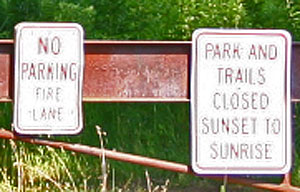
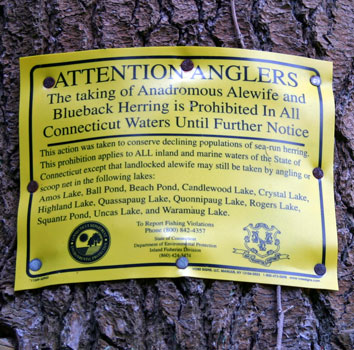
No fishing for Alewives. Attention snitchers: see the 800 number at the bottom of the sign to turn in bad guys with your cell phone. |

No, No and No! Is pounding nails into live trees considered "defacing park property"? |

In 2004 and 2005 almost one million dollars was spent on the much neglected Supply Ponds park in Branford. The Branford Land Trust, a powerful local organization that believes in preservation as opposed to conservation, spearheaded the project by securing funding from a list of taxpayer supported organizations. At stake was the lowly alewives, a migratory fish that drew its name from its resemblance to corpulent female tavern keeper ("ale-wife") according to Wikipedia. Local lobster men often used alewives for bait. In the 1950's alewives invaded the Great Lakes from the sea via the newly opened Welland canal and aggressively spread and caused the decline of many native fish species. Occasionally they would die off in great numbers and their rotting carcasses would wash up on the lake's shores.
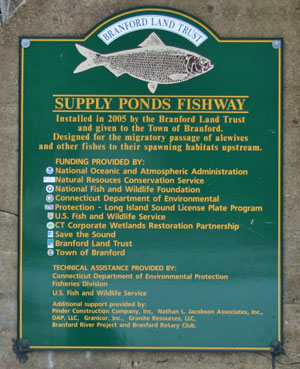
Alewives are now part of the Supply Ponds ecosystem and the Branford Land Trust routinely leads groups of school children to the fish ladder while gleefully explaining how they are restoring the ponds to their "natural" environment. No mention is made that the dam and resultant ponds were made by man just 100 years ago. The ponds are rapidly filling with silt and losing their ability to support aquatic life a little more every year. Eventually the ponds will turn into a swamp and then a bog.
Two huge, 10 foot billboards, one at either end of the trail leading to the fish ladder, proudly list the actors and their mostly taxpayer funded accomplishments for all to see.

Just up a small hill from the million dollar fish ladder stands an impressive, 20 foot tall monolith made of expensive Stony Creek pink granite. Weighing over 10 tons a crane was needed to place this monumental marker in place when the fish ladder was built. Oddly, chunks of pink granite also block one of the former automobile turnoffs at the Supply Ponds Park and the entrance to the 50 car parking lot. What is the significance of this expensive rock being used as a monumental marker and costly auto barriers? One theory holds that most of the wealthy environmentalists and preservationists live in the Stony Creek section of Branford which in turn is known world wide for its pink granite. Thus, like a dog marking his territory by peeing on a fire hydrant, the environmentalists simply plop down multi-ton chunks of pink granite. Perhaps then, it is not surprising that a pink granite floor was recently installed in the entranceway to the Branford Town Hall.

Mother Nature has her own marker for the radical environmentalists and preservationists; poison ivy. The noxious weed that causes people's skin to blister and burn is prolific and hardy. Unfortunately it has found a welcoming home for many decades in the Branford Supply Ponds and Trolley Trail parks. Now it infests large areas of both. It is an enduring legacy to official neglect and in a perverse way furthers the alienation of people from what once was considered recreational land set aside for the "enjoyment and benefit of the people".

Parker Memorial Park, The Trolley Trail and Supply Ponds Park represent changing attitudes towards man and his relationship with his natural surroundings in the town of Branford, Connecticut. The traditional English Garden style park clearly appeals to the greatest number of Branford residents as evidenced by their visits. Ample facilities and hospitality at Parker Memorial Park welcome the visitor and makes it difficult for them to leave when the sun sets. The Trolley Trail is a post modern park that utilizes stage props to set up a tension between what is and what once was. Visitors are given opportunities to briefly reflect upon their surroundings and then are quietly urged to leave by the lack of amenities. The Supply Ponds Park places the needs of lowly predatory, bait fish over the recreational needs of people. Visitors are made to feel unwelcome with signs that admonish their presence with phrases like "Leave No Trace". Facilities and amenities are non-existent and automobile parking is intentionally scarce.

The differences in Branford's parks highlights the change from traditional conservation which believed that nature should be protected and managed so people may enjoy its benefits for all time, to the post modern and radical environmentalist's view that man is destroying nature. The radical preservationists agree with the environmentalists and maintain that the land is best served when people leave "no trace" of their visit. The result is a belief that nature can only be protected by preservation, which inhibits or outright bans man, from interacting with his natural environment. Perhaps the next park improvement project in Branford will surround the public land with a 20 foot tall, gateless fence that is adorned with billboards listing actor's credits and "NO" signs. People will be allowed to stand for a few minutes outside the fence and passively watch the beauty inside like a movie on their television. Then because they are human, destroyers of the natural world, they will be urged to leave and let Mother Nature live in solitary peace and quiet.
Click on the "ADD THIS" button to:

What do you think of this page? How can it be improved? Do you have questions about its content? Share your thoughts with Tim and other readers by clicking on "Leave a message". I read every message and will respond if you have a question.
| A word from our $ponsor, Ads by Google |

Page 1 A Changing town center |

My Old Hometown Table of Contents |

Page 3 Everyone loves a parade |
 Certified by:


|